
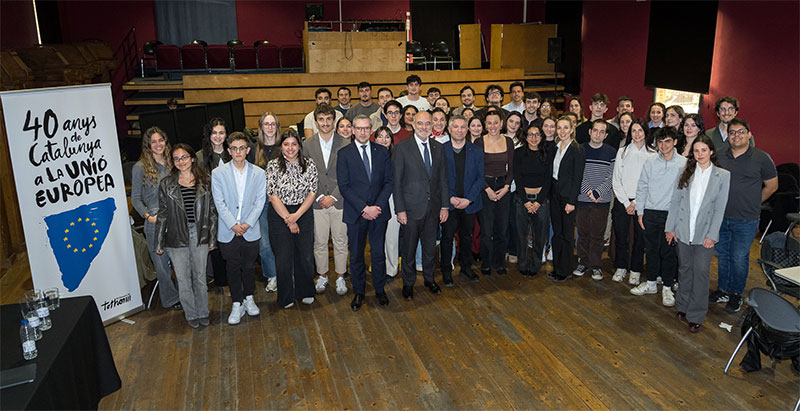
Conference

Marking 40 years of Spain in the EU, youth groups were consulted on their views on various Europe-related issues

Members of the Fundació Catalunya Europa Take Part in the Youth and European Democracy Conference


A Conference by Young People and for Young People

Yesterday, a conference took place with an objective that was both uncommon and deeply necessary: to listen to the voices, opinions, and perspectives of young people on the challenges facing Catalan and European society, on the occasion of the commemoration of forty years since Catalonia’s entry into the Community. Far from the traditional academic format, the event embraced a participatory and decentralised methodology.

A Different Format for a Generation That Wants to Be Heard

From the outset, the session moved away from the model of keynote lectures, adopting instead a small-group debate format. Each group would later appoint a delegate to present its conclusions to the minister.

At the beginning, participants were divided into thematic tables according to their prior selection. There were five thematic axes: democracy and human rights; economy, employment and social rights; climate emergency and ecological transition; technology and digital sovereignty; and security and global affairs. This structure enabled closer and more in-depth discussions among participants, guided by a moderator.

An Opening That Places Europe Between Values and Uncertainty

After a brief period for participants at each table to get to know one another, the session began. Introduced by …, … went on to present the motivations, intentions and objectives of the event, while also highlighting the two sides of the European project: the values it embodies and the historic prosperity it has brought about, but also the possibility that it may fracture or become distorted under the pressure of the historical and multifaceted crisis we are currently experiencing. It is here that young people, as a generation with their eyes firmly set on the future, contributed their grain of sand.

Intense Debate and Forward-Looking Conclusions

Following the initial presentation, a debate period of approximately one hour took place among the members of each table, which consisted of around ten participants and was facilitated by a moderator. Once this time had elapsed, delegates from each group were selected to briefly present the issues discussed, not only to all those in attendance, but also to the Minister for Foreign Affairs and the European Union, Jaume Duch.

During the conclusions session, sensitive issues were addressed and the situation of deep crisis was discussed; however, proposals to address these challenges were also put forward, demonstrating that there is still a small window of opportunity to bring about change. Among the wide range of topics discussed were the lack of inclusion of many demographic groups in institutional representation, the reactionary drift among young people, the housing crisis, issues of social mobility, and the need for an integrated, ecological and sustainable policy that benefits all social sectors (and not just a minority). The need to achieve technological sovereignty was also highlighted, as well as the importance of establishing—on our own terms, that is, in line with our values—what we want technology to do and what we do not. Finally, it was noted that Europe is experiencing a security crisis, which is not necessarily based primarily on wars, armies, and bombs, but also on logistics, influence, economic power, and diplomatic relations.

Finally, Minister Duch took up some of the proposals that had been put forward, briefly developing them and expressing openness to the possibility of holding future sessions of this nature.


Tags